Monday, 16 November 2015

Ho Chi Minh City 1 - An enlightening Conference


International Rubber Conference 2015

The National Anthem of Vietnam came on the air. There was absolute silence as everyone in the Conference Hall stood at attention.

On 2nd November, 2015, my husband and I were in Rex Hotel, Ho Chi Minh City (HCMC), Vietnam, attending the opening ceremony of the International Rubber Research Conference 2015.

After the anthem, Mr Phan Thanh Dung, Director of Rubber Research Institute of Vietnam, gave a Welcoming address. This was followed by Opening addresses by H. E. Dr Ha Cong Tuan (Deputy Minister, Ministry of Agriculture and Rural Development); Mr Nguyen Tien Duc (Deputy Director General, Vietnam Rubber Group), and Datuk Dr Abdul Aziz bin S A Kadir (Secretary General, International Rubber Research Development Board) (IRRDB).

Mr Phan Thanh Dung

H.E. Dr Ha Cong Tuan

Datuk Dr Abdul Aziz

Thereafter, Datuk Dr Abdul Aziz (from Malaysia) chaired the following Keynote addresses: (1) Natural Rubber Producers’ Expectations towards the Research and Development Community by Dr Tran Thi Thuy Hoa, (2) Impact of Latex Harvesting Technologies on Profitability of Rubber Plantations & Smallholdings during Periods of Low Rubber Prices by Dr Sivakumaran A/L Seenivasam, and (3) Nanomatrix and Mechanical Properties of Natural Rubber by Assoc Prof Dr Kawahara Seiichi.

The IRRDB Young Scientist Awarding Ceremony followed. Ms Mily from Indonesia was awarded the IRRDB Young Scientist Award.

Speakers from various countries then gave their presentations. They spoke on topics related to the growing and processing of rubber. Topics included: (1) Plant Breeding I & II, (2) Biotechnology, (3) Agronomy, (4) Rubber Processing & Waste Treatment, (5) Crop Physiology & Latex Harvesting, (6) Plant Breeding, (7) Rubber Technology & Standardization, ( 8) & (9) Plant Protection, (10) Crop Physiology & Latex Harvesting, (11) Establishment of Carbon Cycle System with Natural Rubber and (12) Socio-economy.

Besides Vietnam, participants came from Malaysia, Philippines, Indonesia, Sri Lanka, India, Cameroons, Nigeria, Ivory Coast, France, Myanmar, Cambodia, China and Guatemala (South America).

The last panel session was on “Research & Development in the Rubber Low-price Circumstance”, chaired by Datuk Dr Abdul Aziz. In his concluding remarks, Datuk Dr Abdul Aziz thanked the organising committee (namely Mr Phan Thanh Dung, Dr Nguyen Ngoc Bich, Mr Do Kim Thanh, Mr Phan Dinh Thao, Mr Huynh Huu Hien, Ms Phan Hai Yen, Dr Tong Viet Thinh and Dr Nguyen Anh Nghia), for the well-organised and successful Conference. 


a) Participants and RRIV staff outside the Conference Hall
b) Participants and RRIV staff outside the Conference Hall
c) The writer with Dr Chee Yan Kuan and staff of RRIV


The Conference stretched for three days from 2nd November to 4th November. My husband, Dr Chee Yan Kuan, presented his paper “Intergrated Weed Management in Rubber” on Day 2. Day 3 was a field trip to visit a plantation and the Rubber Research Institute of Vietnam (RRIV). Day 4 was for Meeting of the IRRDB Committee of Directors and Chief Executives and Day 5 was for the Meeting of the Board of IRRDB.

Dr Chee Yan Kuan giving his presentation


Speakers of Plant Protection II     Photo: Dr Nguyen Anh Nghia

On Day 3, about 200 participants in 6 buses visited the Phuoc Hoa Rubber Company and Lai Khe Rubber Experimental Station. 

The buses started off at 8 am from different hotels where participants stayed, and arrived at the Phuoc Hoa Rubber Company (65 km from HCMC) at 9.30 am. The participants were welcomed by the Company’s Director-General, Mr Le Phi Hung. The company is one of the largest rubber companies in Vietnam and it was listed on the Ho Chi Minh Stock Exchange on 18th August 2009.

The participants were shown various techniques used in the plantation: tapping of rubber trees, latex collection and performance of high spraying of fungicide to control leaf disease. The participants also visited the Company’s rubber wood processing factory and Tan Binh Indurstrial Park. 
                

A good tapping knife   Photo: Yap K J

Latex collecting centre   Photo: Yap K J

The rubber trees in the plantation were well maintained with the interrows sparsely covered with soft grasses. Fertilizers were applied in the silt-pit to minimise surface run-off and leaching. Tapping standards were good and tapping trees were fixed with rain guards.

The rubber trees were well maintained   Photo: Yap K J


Tapping trees fixed with rain guards   Photo: Yap K J

The hospitable host gave a lavish lunch for all participants. After lunch, the participants visited the RRIV office at Lai Khe - Binh Duong.

The RRIV office at Lai Khe - Binh Duong.was impressive. It has a new building which was completed in 2013. Four divisions (Breeding, Agrochemistry and Soil, Crop Protection, Latex Physiology and Harvesting); two centres (Rubber Technology and Natural Rubber Quality Control); and Lai Khe Rubber Experimental Station are located in this area.

Besides that, RRIV also has two centres and one Rubber Experimental Station situated in other regions of Vietnam (Centre for Rubber Research & Transfer of Technology in Highlands; Centre for Research & Development for Rubber Smallholders and Phu Yen Rubber Experimental Station).  

There are 140 researchers, 40 technicians, 400 administrative staff and workers in RRIV. The total area of the Institute is more than 1000 hectares.

RRIV new building at Lai Khe - Binh Duong         Photo: RRIV   

The participants were first shown the Hevea Germplasm Garden where the IRRDB exchanged clones and rubber clones were planted. Following this, participants visited the budwood nurseries where the clones were propagated and multiplied for research and later supplied as recommended budded clones to rubber smallholders and plantations.

Briefing of rubber clones   Photo: Yap K J

The International Rubber Conference and IRRDB Annual Meetings were conducted smoothly and efficiently. The participants learnt the latest technology, updated their knowledge, progress and challenges of each country and exchanged ideas on how to solve problems like the current low price of rubber.

There was a gala dinner on Day 1, hosted by RRIV. The dinner was on board a brightly lit-ship that cruised along the Saigon River while guests dined. The chefs prepared a sumptuous spread with seafood galore: big prawns, oyster, fish, squid and many unique Western and Eastern cuisine.


Guests waiting for the arrival of the brightly-lit cruise ship

A sumptuous spread of seafood

After dinner, Datuk Dr Abdul Aziz thanked the hosts for the splendid gala dinner. This was followed by  presentation of certificates for trainees who completed the course. 

There was entertainment by ethnic dancers and a live band with a talented drummer who wowed the audience with many catchy numbers.

Ethnic dancers in beautiful ao dai costumes

The band with the talented drummer

All good things must come to an end. As the guests leave the ship, many took the opportunity to take photos with the dancers. 

A photo with the charming dancers
On our last day at the Palace Hotel, the few of us from Malaysia bade farewell to some of the participants from different parts of the globe.


Saying farewell to participants from Sri Lanka, Ivory Coast, Nigeria and Indonesia.

Attending the conference in Ho Chi Minh City opened my eyes to rubber growing in other countries. It was an enlightening experience.


Thursday, 29 October 2015

The beauty of potluck


Yee sang, a raw fish salad
 
BRING a special dish. Relax and relish. Enjoy the company – and food.
It’s a potluck party!

My first encounter with potluck was during my stay in Belgium many
years ago. We were a close-knit group of multiracial Malaysians and informal
gatherings during the weekends spiced up our lives. Each family prepared a dish
and we relished authentic Malaysian food in a foreign country.

Back in Malaysia, I continued with this special way of getting people
together and it is a worthwhile way of entertaining. You don’t have to bother to
dress up for the occasion - informal gatherings in the home are relaxing.

Food is cleaner and healthier and you can cater for people of all ages.
There is more space and you can make as much noise as you like. Besides, it
does not burn a hole in your pocket! You can have potluck breakfast, brunch,
lunch, tea or dinner – whatever is appropriate for your group. With potluck, the
idea is to take away the hassle of food preparation.

Gatherings at home are favourable if you have small children – parents
go through unnecessary stress in restaurants! Senior citizens with incontinence
or mobility problems feel more comfortable too.

People who like to cook enjoy sharing their culinary skills with others.
During one potluck tea, a friend brought a delectable cheesecake complete with
the recipe for distribution too!

Generally, after the initial excitement, guests settle down. When the taste
buds are satisfied, conversation flows.

However, a potluck party must be organised. If you allow your guests
to bring whatever they like, you will end up having too much of one type of food
– once, four of my guests brought fried chicken for a potluck!

First, call up enthusiastic guests who love to cook. Sound out the three
main dishes - meat, seafood or vegetables. Let them choose the dish but make
the cooking method a secret – otherwise there will be no thrill!

A vegetable dish: mouth-watering mushroom

The rest can bring dessert, home-made or bought from a special bakery.
The host provides the drinks, cutlery and place. You can rotate playing host so
that you get to visit others’ homes too.

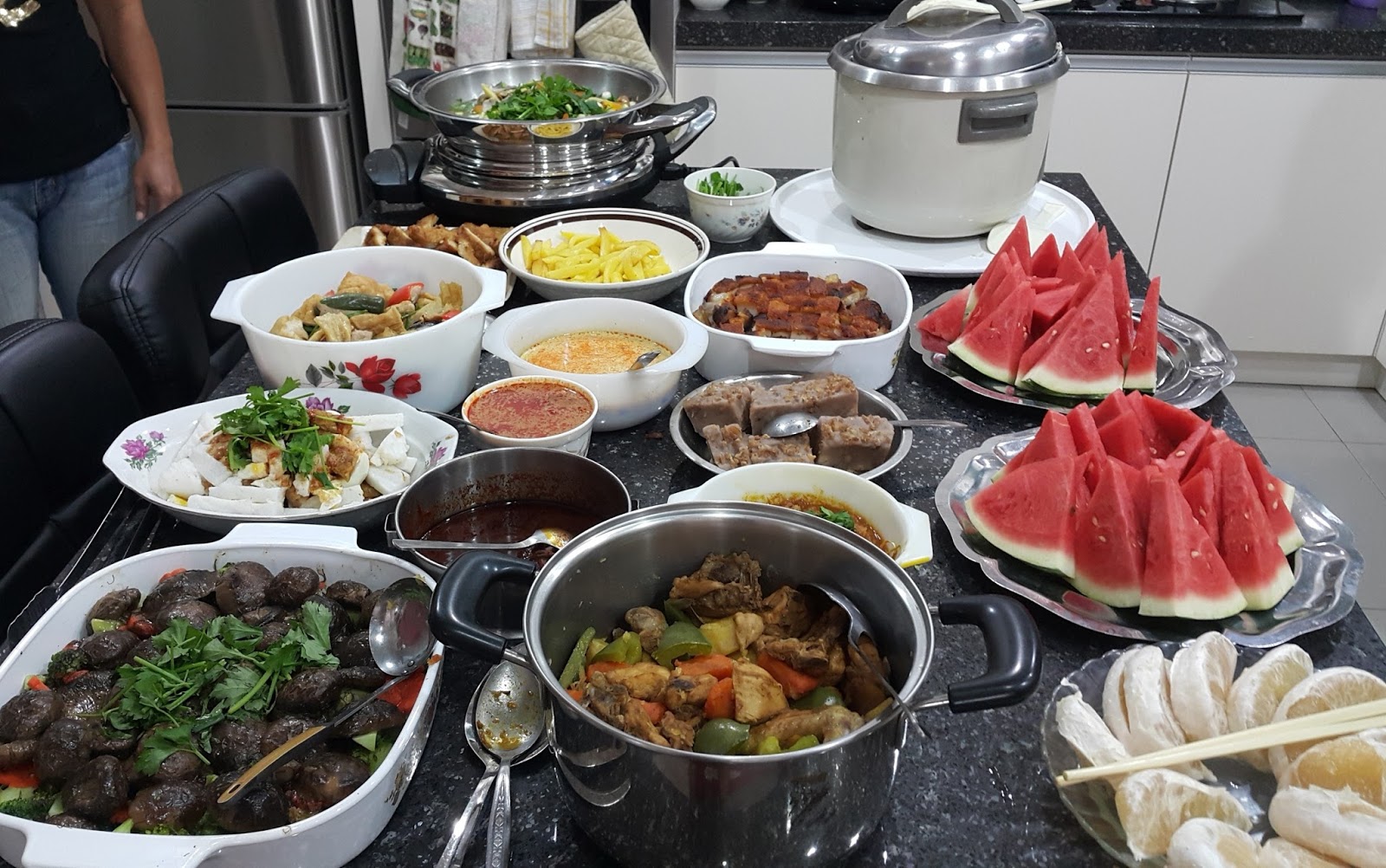
A simple family potluck gathering


The most memorable potluck party in my home was during one Chinese
New Year. It was a family gathering – the guests’ ages ranged from three to 76
- and cousins from all parts of Malaysia were present. Some had not seen each
other for many years.

We started the ball rolling with yee sang, a raw fish salad. About 50 of
us were doing the loh hei in varying decibels as we tossed the ingredients as
high as we could, reflecting the high spirits we were in.


Loh hei


Once, I had a potluck party with relatives in San Francisco. I brought along a box of dried yee sang ingredients from Malaysia. With some local fruits there like pear, apples and cilantro, we had a fun time, tossing the ingredients for prosperity in business. Loh hei is not practised overseas or in any other part of the world, so it was a novelty for my relatives.

Potluck overseas, with yee sang and other dishes


Loh means “mix” and hei means “high” in Cantonese but together it
means to “prosper in business” for the year. As chopsticks clinked, cameras
clicked and candid shots were captured.

Other dishes were acar, bak kut teh and herbal chicken to name a few. The acar
(a spicy pickled vegetable) was my late Aunt’s (Ah Yee) specialty and I am
lucky to have learnt it from her. I like to prepare this dish because of its colourful,
appetising, sour and spicy flavour, and because I can cook it a day earlier.

Acar

 Bak kut teh (BKT), originating from Klang, is a Hokkien herbal meaty
dish, flavoured by intoxicating herbs. I cooked BKT the traditional way, with
pork ribs, bean curd skins and mushroom. BKT goes well with rice but my
deep-fried dough fritters (yau char kwai) had everyone drooling with joy that
day. For people who do not take pork, BKT tastes just as good with chicken,
beef balls, seafood or just vegetables.


Bak Kut Teh with pork
Bak Kut Teh with seafood


My herbal chicken, an adaptation of “Beggar’s Chicken”, was a hot
favourite. Legend has it that a starving beggar wrapped a chicken in mud and
threw it in a fire to bake. When cracked open, he found the meat tender and
flavourful. The Emperor, who was passing by, was drawn by the fragrant aroma.
He stopped to dine with the beggar and found the dish so delicious that he
added it to the Imperial Court menu.


Herbal chicken


In Malaysia, Beggar’s chicken is served in some restaurants. Chefs cook
this dish with stuffed herbs. They wrap the chicken in lotus leaves and cover it in
clay before baking it, ensuring that the juices are sealed. I tried cooking this dish
with various herbs in the microwave oven, the crockpot and electric oven. To
make it simple, I cooked it without any lotus leaves or clay. The herbs gave the
chicken a distinctive flavor and the meat turned out tender when cooked in the
microwave, juicy when using a crockpot and crispy when roasted in the oven.
On that special day, my herbal chicken was cooked in the crockpot and
the chicken with its juicy herbal sauce was the most popular dish.

The variety of desserts that day was staggering. There were jelly of
many flavours, rojak, an assortment of kuih and Western cakes and many types
of fruits – besides the mandarin oranges. Then there was the surprise item – the
durian – “finger-licking good” varieties of D2, D24 and D99, brought by a cousin..

 
Durian: finger-licking good

A feeling of togetherness and cheerfulness prevailed. Towards the latter
part of the evening, the guests – toddlers, teenagers, working adults and seniors
- formed their own informal groups. The younger set played indoor games;
teenagers exercised their vocal chords to the accompaniment of music; working
adults of different professions exchanged ideas while the seniors engaged in long
chats of days gone by.

Potluck gatherings are fun.They are simple ways to keep in touch, to
relax and enjoy food. They are easy on the pocket too. Getting together to
enjoy our vast variety of food is our Malaysian way of life.

 ...................................................................................................................
This article was published in the Star (Malaysian newspaper) on 9th October 2001.
It is edited and photos are added here.
It is also published in my cookbook "Quick and Healthy Meals" where recipes
are given for the dishes described.
For more information, please write to:
quickandhealthy@yahoo.com


Wednesday, 14 October 2015

Popiah party, anyone?


Popular popiah: a healthy nutritious wrap

 “I’m having a popiah party this Sunday. Are you free to come for lunch?”

Whenever I pose this question to my friends or relatives, I get a positive
response. Most are intrigued by the idea of a popiah party and are ever-willing
to try this new experience.

Malaysians of all races, young or old, rich or poor, enjoy food and popiah
is a favourite appetiser. It can be quite pricey if you eat out – one piece may
cost from RM 1.00 to RM 1.50 - so an invitation to a popiah party is always
welcome.


Young people - cousins - enjoying popiah  together

My guests are usually small groups of 10-12 people. We sit at a round
table with the ingredients placed in the centre on a Lazy Susan.


Guests sit at a round table with ingredients in the centre

Popiah, a potpourri of vegetables and meat wrapped in membranous flour
skin, is a Hokkien dish. Almost every Malaysian enjoys it.

The traditional vegetables are yambean, carrots, long bean, lettuce,
cucumber, bean curd, eggs and fried shallots. Often meat, like Chinese sausages,
prawns or chicken is added. Other variations include French beans, spring
onions and bean sprouts. Chilli and sweet sauce are spread on the skin. Some
people enjoy popiah with caramel and groundnut topping.

Ingredients for the popiah wrap

Most of the ingredients, raw or cooked, are cut in thin strips. I often use
electrical kitchen appliances to help me do the job quickly and efficiently. You
can invite your friends to help you prepare the ingredients and this leads to
much laughter and merriment as well.

A popiah party is good for socialising. As we make the rolls, the
conversation will flow. The whole process of scooping the ingredients on to the
skin and folding it to make a tube-like popiah takes some time, so the tongue
works full time as the fingers move.

Popiah party: good for socialising

I enjoy watching my guests as they make their individual popiah roll. While
most spread the sauce first, followed by lettuce and the rest of the ingredients,
others will do the opposite, adding the sauce last! It is fascinating to study “knights
of the round table” doing the “roll call”.


Wrapping popiah: fold popiah skin from one side

Wrapping popiah: fold the two sides

Wrapping popiah: roll into a compact tube


Some weigh and calculate the calories mentally as they spoon the different
ingredients indecisively. Some use their fingers to pick the item they like best and
nibble on it while they talk.

Some make thin, compact and delicate rolls while others make full and
large ones that burst at the seams. Sometimes the ingredients and sauces leak
out after the first bite!

Men generally make terrible popiah. Instead of folding the skin from one
edge, some do it both ways, forgetting to tuck in the sides. With the “opened
parcel” in their palms, they will be at a loss as to which end to bite first. Usually,
they will resort to using fork and spoon to eat their “helpless heap” much like
eating a plate of salad. Anyway, patiently or painfully packed, the popiah will
result in satisfactory grins once it is tucked safely in the stomach.

Popiah is a balanced meal: nourishing and healthy. It is good for those on
a diet too. There is none of the bloated feeling that often comes with a meaty
meal. The vegetables are rich in vitamins and antioxidants. Minerals like calcium
and iron – very important for children and senior citizens – are found in beancurd
(tofu) and dark green, leafy vegetables. Popiah is low in cholesterol and high in
fibre too. “I make popiah almost every day for my husband. It gives instant relief
to his constant constipation,” a senior friend told me laughingly.

So, try a popiah party and feel the difference. It is ideal for seniors: a
healthy diet that is anti-aging. Get together and have fun doing the preparation
 together as many hands make light work.

You can have potluck popiah too – where everyone prepares one item
and you come together for the final combination.

Around the world, people enjoy their own kinds of popiah. Hong Kong
tim sum usually includes the fried version of the popiah which is crisp and crunchy,
or the steam version which is soft and meaty .


Fried popiah


Steamed popiah

Temaki sushi is a form of rolled sushi. It is made up of a rolled cone of seaweed, wrapped around rice and fillings. Fillings can be any fish, prawn and vegetables example salmon, unagi (Japanese eel), crabmeat, lettuce, avocado or cucumber.

A temaki sushi of  rice, lettuce, cucumber, unagi and avocado.

Mexican burrito is a wrap of rice, black beans, grilled meat, salsa, onion,
tomato and cheese, folded with a thicker popiah skin called tortilla.


Mexican Burrito folded with tortilla    Photo: Angela Wong

Mexican Burrito: with  rice, black beans, grilled meat,salsa, vegetables and cheese
Photo: Angela Wong

Vietnamese popiah – made up of a thin papery rice flour wrap of meehoon, carrots, shallots,
prawn or other meat and Chinese parsley – is often dipped in a sour, spicy,
sweet sauce.

Vietnamese popiah

These different versions of popiah from different parts of the world are
mouth-watering, each with its individual distinctive flavour. Be adventurous and
try different variations of the popiah. Enjoy socialising in this healthy nutritious
wrap.

Popiah anyone?

.....................................................................................................................
This article was published in the Star (Malaysian newspaper) on 25th December 2000.
Photos are added here. A popiah now in 2015 costs Rm 1.50 to Rm 2.00.
This article is also in my cookbook "Quick and Healthy Meals" together with
the popiah recipe. The book costs Rm 25 and is sold in Klang, Malaysia.
For more information on the cookbook, please write to:
quickandhealthy@yahoo.com

Sunday, 4 October 2015

Fowl play in the kitchen


Chicken rice - a luxury item in the 1950s

WHENEVER I eat chicken rice – Ipoh chicken rice, Singapore chicken
rice or home-cooked chicken rice – warm memories of the 1950s flood my
mind. As a little girl, I was overjoyed whenever my mother cooked chicken rice,
which was considered a luxury item then. We had fish and vegetables daily – a
whole chicken was relished only on special occasions and festivals.

Incidentally, a cardiologist, a family doctor, speaks highly of the diet of
the 1950s and 1960s. He laments on the diet of Malaysians today. “The present
generation eat too much meat,” he says. “We should revert to the types of food
our mothers and grandmothers used to prepare – especially green vegetables
stir-fried with slices of meat or fish.”

“Look at the dinner dishes at social gatherings – they are mostly meatbased
with only one or two vegetable dishes. If you really love your heart, you
should eat less meat and more vegetables and fruits,” he advises.

Coming back to chicken rice, it is a favourite fast food of Malaysians. As
a senior, I often cook chicken rice when I need to serve food at short notice. My
chicken rice is prepared, “press-button” style. I cook the rice (with some butter,
salt and chopped garlic) in the electric rice cooker by pressing the “rice cooking”
button. I steam a marinated chicken over the boiling rice. Once the button springs
to “keep warm” mode, my chicken-cum-rice is ready. With a simple vegetable
soup, sliced cucumber and chilli sauce, my chicken rice can be served in a little
over half an hour.

Chicken rice - a favourite fast food of Malaysians

My mother’s chicken rice in the good old days was prepared differently.
In those days, we did not have a refrigerator. If we wanted to eat chicken, we
had to buy it, live, from the market. I used to watch my mother slaughtering the
chicken effortlessly in the kitchen. This is something most modern mums do not
(or do not know how to) do.

Gripping the fowl deftly with her left hand, one finger curled around its
legs and the other fingers holding its wings and head, Mother used her right hand
to pluck the feathers from a delicate spot on the fowl’s neck before she slit its
throat. Then, holding the chicken upside down, she collected the blood in a
bowl that had water and salt in it. Urgh! I could never do that – I would really
chicken out and faint on the spot!

I remember one funny incident when the chicken nearly got away. My
siblings and I had gathered around to watch Mother teach a relative, Jen, the art
of chicken-slaughtering. Jen lost control and the chicken got away because she
did not slit the throat correctly.

There was pandemonium in the kitchen as the chicken pranced and
paraded around with its head cocked sideways while the adults gave chase.
Can you imagine the din when the aluminium tins did somersaults during the
chase? When the chicken finally landed on the dinner plate, my siblings and I
lost our appetite!

Coming back to the slain fowl: it was soaked in hot water for a while.
Mother then teased out the chicken’s feathers with her bare hands. It seemed so
easy! Nowadays, the vendor in the wet market de-feathers the chicken in a
machine. He throws away most of the internal organs, but in the 1950s, most of
the entrails were retained and relished at the dining table. The word “cholesterol”
was not in our vocabulary yet.

The coagulated blood, cut into cubes, was fried with chives and tofu.
The small intestines were fried with green vegetables. Chicken liver, gizzard and
heart were cooked with black sauce or fried with other green vegetables.

As for the chicken, Mother cooked it her way – “submerged style”.
First she boiled some water in a big pot. Then she placed the whole chicken in
it, fully submerged. After 20 minutes, she turned the chicken and let it stay
submerged for another 20 minutes. “The chicken meat will be cooked perfectly
this way – not overdone,” she remarked.

The rice was prepared differently. Mother fried the washed rice with oil,
garlic and salt before placing it in a pot with the correct amount of “soup water”
(from the pot that cooked the chicken). All the cooking was done with firewood.
She had to watch the fire, controlling the “high” and “low” by adding or removing
firewood – there was no “keep warm” mode like that found in present-day
electric rice-cookers. Mother cut the cooked chicken into bite-size pieces,
arranging them evenly with the choice portions – the drumsticks and wings –
pointing in four directions. This is because we children were not allowed to pick
and choose our favourite chicken pieces; we had to eat the piece on the plate
that was facing us!

Mother’s traditional chicken rice was served with her special “ginger
dip” – finely chopped ginger, salt and oil. Together with soup, sliced cucumber,
vegetable dishes with yummy entrails, my siblings and I would tuck into the
chicken rice extravaganza with gusto. Although Mother’s chicken rice took
hours to prepare, she was rewarded by our happy and satisfied responses.

4 generations ready to enjoy chicken rice in 2014

On reflection, I feel glad to be in today’s high technology age. I buy my
chicken all dressed up and nicely packed from the hypermarket. Modern
appliances like rice-cookers, gas burners, slow-cookers, pressure-cookers and
microwave ovens are indispensable kitchen appliances. I cannot imagine starting
a fire with matches and firewood every time I need to cook (except of course if
I’m camping in the woods).

Anyone game for chicken rice: press-button or firewood style?

...........................................................................................................................
This article was published in the Star (Malaysian newspaper) on 26th May 2003. 
More photos are added here.
This article and the recipe for chicken rice, is published in my cookbook, 
"Quick and Healthy Meals".
For more information on the book, please write to:
quickandhealthy@yahoo.com