|
| Route map of Central Asia Map: Choo Kok Wai |
Uzbekistan is a country of outstanding architectural wonders, mesmerising
history, fascinating culture and unique food.
After a memorable Silk Road adventure to Xinjiang in 2010, my fellow
travellers were eager for another adventure. Choo Kok Wai, organizer and tour leader,
chose Central Asia (CA). We concentrated on Uzbekistan, Krgyzstan and
Kazakhstan.
CA fascinates because in ancient times, these were countries along the Silk
Road. The countries in CA are new, having become independent in 1991. Each
country in this region has its own identity, history and architecture.
Previously ruled by Persia, Greece, Arabia, and lastly by Russia, the influences
from the past have resulted in a vibrant culture.
We set off on our CA holiday in May 2012. There were 33 of us. From Kuala
Lumpur, we first took a flight to Tashkent, capital of Uzbekistan. Uzbekistan
is a land-locked country. It has borders with all of the other 4 Stans of CA as
well as Afghanistan.
As a country of ancient cities, Uzbekistan was the main transit route of the
Great Silk Road. Touring these countries was an eye-opener for me. During my
schooldays in the 1960s, I had never heard of them in History or Geography lessons.
Visiting them was like a discovery adventure for me.
Our first night in Tashkent, at Miran International Hotel was unforgettable
. Abdullah, our manager cum guide (who was also our
manager on our Silk Road Adventure), welcomed us. We had a sumptuous dinner at
Sim Sim Restaurant. The dessert, baklava, had us all drooling with delight. It
was the best baklava I have ever tasted.
 |
| Best baklava tasted |
Uzbekistan’s 3 cities: Khiva, Bukhara and Samarkand have been called the
oldest cities in the world. Next morning, we flew to Urgench, right at the
start of CA’s Silk Road, and Khiva
KHIVA
Our local guide was Takhir. In Khiva, we first visited Itchan Kala, a walled ancient city built over a span of 600 years. It became
a UNESCO World Heritage site in 1990.
 |
| Outside the walled city of Itchan Kala |
People still live within the city walls
and we found inside it, minarets, madrassahs (religious schools) and mosques. They were well-preserved examples of the Muslim
architecture of CA.
The weather was hot and dry. Many of us carried umbrellas or wore hats for
protection. As we walked along the streets together, we could feel an air of
festivity around us. Vendors all around us were selling trinkets, clothing and
souvenirs. There was even a local wedding to add to the colourful atmosphere. I found that the most outstanding buildings were the
madrassah and minaret of Islam Hoja.
 |
| Minaret and Madrassah of Islam Hoja Mosque |
The local people, fair, brown-eyed and black-haired, were very friendly. The
womenfolk wore modern colourful dresses. They were as curious about us as we
were about them. The adults and their lovable children were eager have their pictures taken with us.
 |
| With local women in modern colourful dresses |
 |
| Cute children - eager to have their pictures taken |
On our first night in Khiva, we had an open-air dinner in Itchan Kala, under
the Islam Hoja Minaret.
 |
| Open air dinner under Islam Hoja Minaret |
It happened to be my husband's birthday. Abdullah
presented him a colourful Uzbek cap and a birthday cake with a
"fireworks" candle.
 |
| Birthday boy with fireworks candle |
We savoured local dishes while big bosom ladies
in glittery costumes, entertained us to Uzbek dance and music. To add to the
sizzling atmosphere, the dancers invited us to join them. It was a gay and
marvellous start to our CA holiday.
 |
| Big bosom lead dancer |
 |
| Birthday boy dancing with lead dancer |
 |
| Sizzling atmosphere: members dancing with locals |
Next morning, my
husband and I went back to visit Itchan Kala on our own. It was quieter and
cooler compared to the day before. We saw some locals harvesting mulberry
fruits. A man had climbed up the tree and was shaking it, while below the tree;
a few women were collecting the fruits with an outstretched cloth. What a novel
way of harvesting mulberry fruits.
After our lunch
of green noodles (speciality of Khiva), which I found quite bland, we were
off to visit the historical ruins of Khiva: Topraq and Ayaz ruins.
 |
| Green noodles - speciality of Khiva |
|
Topraq and Ayaz Qala ruins were
ancient Khorezm settlements, about 2500 - 3000 years old. Visiting these ruins
gave us an idea of ancient civilizations in CA. We visited Topraq Qala first.
It is rectangular in shape with ruins of palace, towers, temples and brick
walls.
 |
| Topraq Qala ruins |
 |
| Topraq Qala: members listening to Takhir |
We ladies had to tread carefully as we clambered up and down the sandy
soil slopes, holding on to each other for support.
 |
| Ladies holding on to each other |
Topraq
Qala ruins was also a popular site for Uzbek students who came in bus-loads
with their teachers on a study trip.
 |
| School children on a field trip |
The whole area was dry and dusty because of low rainfall and high
temperature. Vegetation was sparse and shrubs that grew were short and thorny.
I was intrigued by unusual flora growing on the dry and arid environment and some
fauna (gecko and arachnid) hiding in the soil.
 |
| Unique plants growing in the arid and dry environment |
After
a tiring climb up and down Topraq Qala, I was too exhausted to visit Ayaz Qala. So
I stayed back with some other members. While resting near our bus, we met some
young Uzbek backpackers, who had cycled to these ruins from Tashkent, the
capital of Uzbekistan.
 |
| Uzbek cyclists |
Back
in Urgench, we had an authentic Uzbek dinner in a yurt in Ulli Hovli village, a
17th century fortress.
 |
| A yurt in Ulli Hovli village |
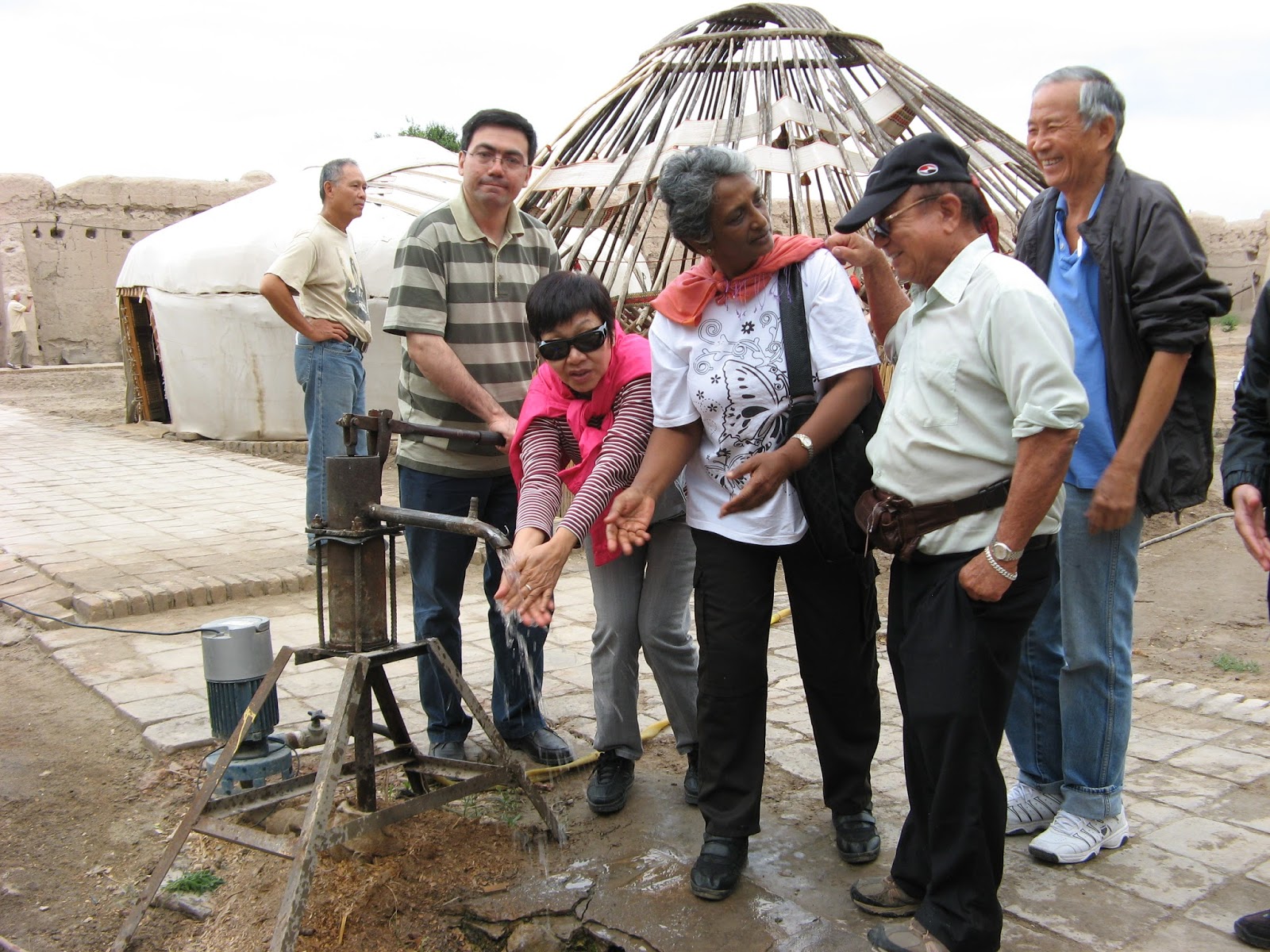
As we entered the village, many of us were excited to find
an ancient pump that pumped out water from underground by pressing on a lever.
We queued up to wash our hands like little kids who had found a new toy.
 |
| Queuing up to wash hands |
I
watched with interest local women preparing naan bread - kneading the dough and
baking it in huge earthen ovens. Walking around the village, we watched other
workers at the stove, preparing our
dinner.
 |
| Making the dough for the naan bread |
 |
| Putting bread into huge earthen oven |
 |
| Huge earthen ovens |
Finally, seated comfortably inside a yurt – we had a delicious Uzbek
meal (mutton soup,
rice pilaf and naan bread) that was prepared right before
our eyes.
 |
| An Uzbek dinner inside a yurt |
 |
| Rice pilaf |
 |
| Mutton soup |
 |
| Naan bread |
To save a day, we took a night train to Bukhara. It was pretty comfortable
and many of us slept well. We arrived in Bukhara next morning, with everyone in
high spirits.
BUKHARA
 |
| Ladies - bright and cheerful |
 |
Guys in high spirits
|
Bukhara, located on the ancient Silk Road, was a centre of trade, scholarship, culture
and
religion for five millennia. A UNESCO World Heritage site, it was famous for
its many mosques and madrassahs. Bukhara's architecture and archaeological
sites form one of the pillars of CA's History and Art.
We
went for lunch in a restaurant with a rustic Russian setting. A Russian lady
played music on a violin. Before long, five local ladies started dancing. They
invited us to join them. Soon, all of us were on the floor, dancing with the
locals like they were our long lost friends. It was an impromptu dance party!
 |
| A Russian lady playing on the violin |
 |
| A dance party- Malaysians with locals |
With our stomachs full and our spirits high, our group was ready to explore
Bukhara. First visit was Poi Kalyan Complex, made up of Kalyan
Mosque, Kalyan Minaret and Mir-i Arab Madrassah.
Built in 1127, the Kalyan Minaret,
used as a beacon and watchtower, was the tallest building in CA. Its 14
ornamental bands, all different, included the first use of glazed blue tiles. I
noticed that many of the buildings were dazzling blue in colour, whether it was
the dome, minaret or roof. All these buildings have been lovingly restored to
their original grandeur with UNESCO assistance.
 |
| Kalyan Mosque and Minaret |
The
Mir-i Arab Madrasah was CA's only functioning madrassah in Soviet times.
Presently, young men from Uzbekistan study Arabic, the Quran and Islamic law in
the Kalyan Mosque while the Madrassah is used as dormitories.
 |
| Miri-Arab Madrassah |
Many
of the historical sites were near each other and within walking distance. We
walked to view other monuments: Labi Hauz with Bolo-Hauz Mosque, Chor Minor and
Nodir Devon Begi Madrassah.
Labi
Hauz means "by the pond". After touring many places in the hot sun, I
found this place by the pond with surrounding mulberry trees, cooling and
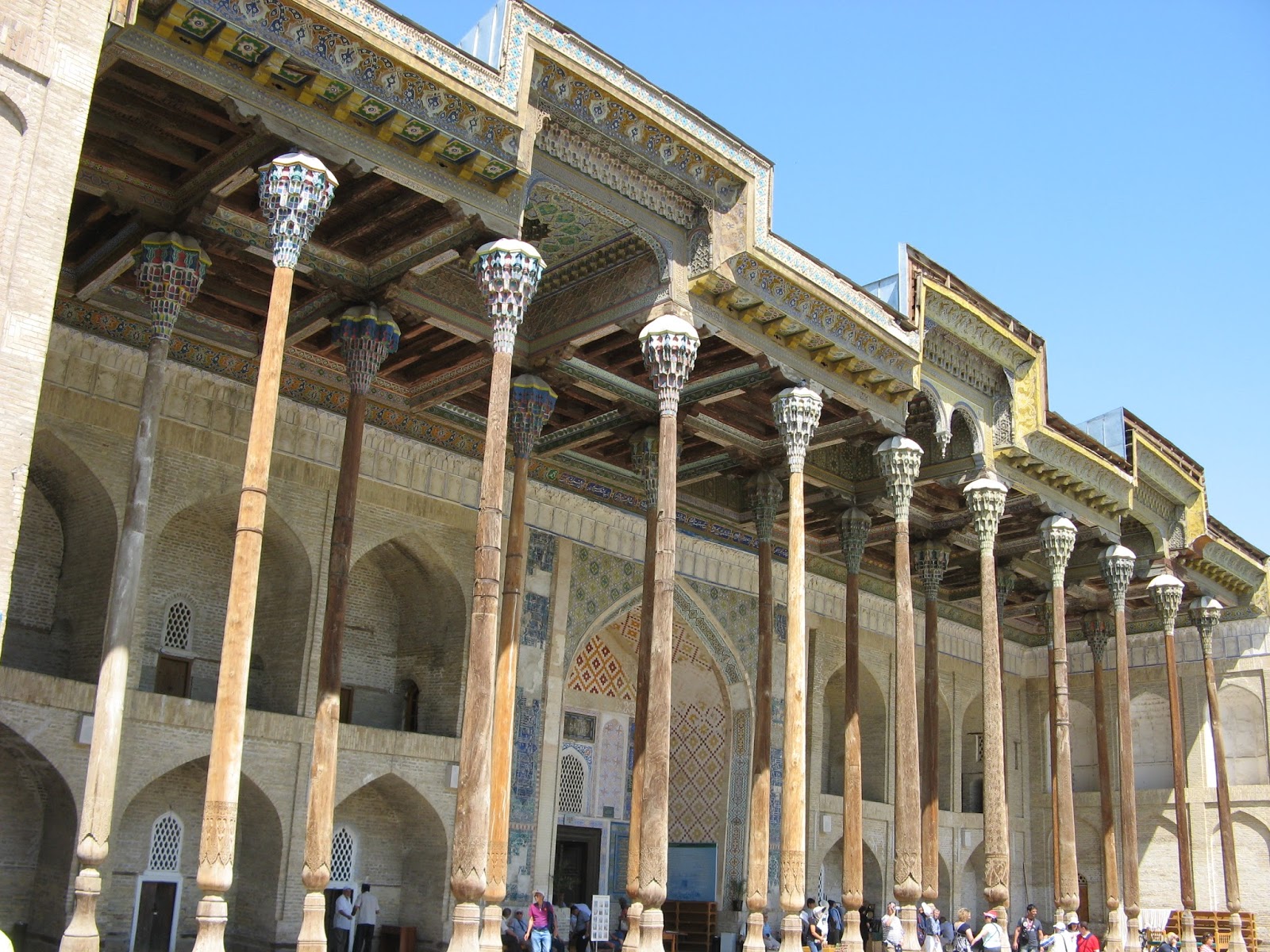
relaxing. It was crowded with tourists and street sellers. The Bolo-Hauz
Mosque, built in 1712, facing the pond, was impressive, with its elegant colourful
wooden columns, ornamental floral patterns and artistic ceiling. It stood out
from the other mosques in the area.
 |
| Labi Hauz with Bolo Hauz Mosque in front |
 |
| Bolo-Hauz Mosque with elegant colourful wooden columns |
 |
| Bolo Hauz Mosque with artistic ceiling |
 |
| Bolo Hauz Mosque with lovely patterned walls |
Hoja
Nasrudin's statue nearby was a hot favourite for our photo enthusiasts. Considered
a populist philosopher and wise man, he is remembered for his funny stories and
anecdotes. He appears in thousands of stories, as a witty, wise, or a
"wise fool".
 |
| With local children and Hoja Nasruddin statue |
The
Nodir Devon Begi Madrasah nearby, built as a caravan serai, was converted into
an educational madrassah in 1630 AD. We were surprised to find that creatures (birds
and animals) and the sun with a human face were drawn on its façade.
 |
| Nodir Devon Begi Madrassah with its unusual facade |
Chor Minor Mosque's most significant feature was the 4 identical blue
minarets looming tall against the blue sky. They represented the 4 ruling
dynasties of Bukhara (Samanids, Sheybanids, Karahanids and Mangits). Between
the minarets was the big dome - the symbol of sky and the single God.
 |
| Ladies in front of Chor Minor Mosque |
Our members were more interested in Chor Minor Mosque’s courtyard. There
were mulberry trees, lovely flowers and souvenirs on sale nearby. Members started plucking the mulberry fruits from the trees and consuming them
with relish - sweet and juicy. They did not mind getting their fingers stained purple!
 |
| Members plucking fresh mulberry fruits |
|
Around the mosques and madrassahs, there were small shops selling a variety
of high quality merchandise. These caught our ladies’ interest: ceramic ware, fancy-shaped
knives and stork scissors, old-fashioned pocket watches, semi-precious stones,
embroidered items and all types of metal ware fashioned by creative blacksmiths.
 |
| ceramic ware |
 |
| Old fashioned pocket watches |
 |
| Fancy shaped knives and stork scissors |
 |
| Semi-precious stones |
 |
| Embroidered items |
 |
| Metal ware |
Our bus then took us to another site. As we walked towards the Ismail Samani
Mausoleum, we passed a big playground. There were many school groups with
teachers walking by. The children, with sun-caps, looked happy and carefree.
They kept staring at us in a curious manner.
 |
| Happy and carefree children |
 |
| Children staring at us with curiosity |
Among the mausoleums that we visited, the Ismail Samani Mausoleum stood out.
Built in the 10th century, it houses the tombs of Ismail Samani, his father and
his grandsons. A cubic building covered spherical dome, it is assembled from
burnt square bricks arranged vertically, horizontally or obliquely. Its
delicate baked terracotta brickwork changes in colour as the sun rise and set
through the day.
 |
| Our group in front of Ismail Samani Mausoleum Photo: Lai Hee Cheng |
 |
| Inside Ismail Samani Mausoleum |
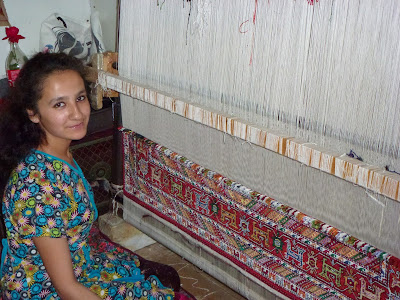
Central Asia is
famous for its magnificent carpets and Bukhara is well-known for its exquisite handmade rugs and carpets. At a carpet
shop, we came face to face with the gorgeous colours and designs of Bukhara’s
carpets. We saw first-hand how carpets were woven, especially by young girls
who were as pretty as the carpets they were weaving.
 |
| Exquisite rugs and carpets |
 |
Pretty girl weaving a carpet
|
|
|
|
Lunch was a meaty affair. We had an Uzbek lunch in a garden with lovely roses as setting: barbecued chicken, beef and mutton kebab, samosa (somsa) and baklava dessert again...yummy!
 |
| Lunch in a rose garden |
 |
| mutton kebab |
 |
| Samosa |
 |
| Barbecued chicken |
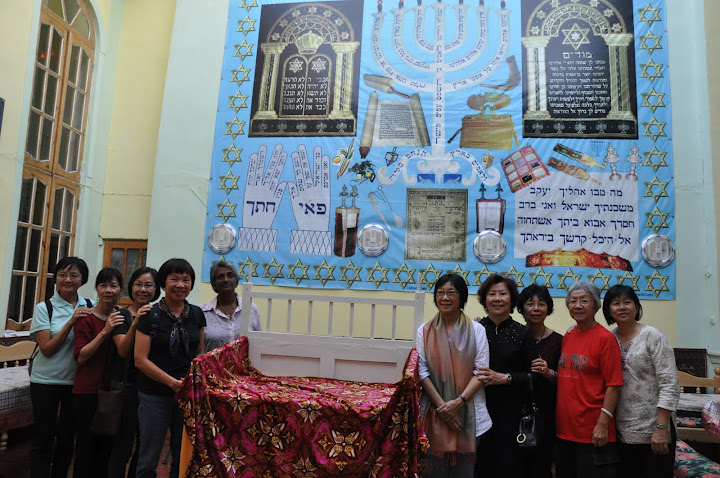
After lunch and before dinner, our time was free and easy. Some of us took a
walk and we came across the sole remaining Jewish synagogue. It was heartening
to see the Jewish community coming together for prayers and studies of the
Torah.
 |
| In a Jewish Synagogue |
That evening, we had dinner together with a fashion show, right inside Nodir
Devon Begi Madrassah. The fashion show and traditional dancing (to promote
Uzbek's cotton industry) were of a high standard. The stunning models wore
striking modern Uzbek couture.
 |
| Dinner in Nodir Devon Begi Madrrassah |
 |
| Traditional dance |
 |
| Traditional dance |
 |
| Modern couture |
 |
| Modern couture |
The next day, our coach took us to Samarkand. We made a detour to Shakhrisabz,
the birth place of Emir Timur (also known as Tamerlane). Timur was a prominent
military commander and outstanding statesman in the 14th century. He is the
national hero of Uzbekistan. Takhir told us many tales of this great Emir
Timur.
We visited Ak Saray Palace, his summer palace which covered an area the size
of an Olympic stadium. The Palace took a quarter of a century to build but sad
to say, it was not completed when he died.
 |
The incomplete Ak Saray Palace
|
 |
| Emir Timur statue - with local girls |
Lunch in a family restaurant was lip-smacking lamb kebabs and noodles. The
kebab was cooked like our Malaysian "satay". You can smell the aroma
of the kebab as you watch the cook at his stove. The meal was delicious at
every bite.
 |
| Noodles in lamb soup |
 |
| Lamb kebab |
 |
| The cook at his charcoal stove |
SAMARKAND
After a satisfactory meal, we were off to Samarkand. Founded in 700 years BC, Samarkand is called 'The Gem of the East'.
Conquered by Alexander the Great in 329 BC, it became the key trading centre on
the Silk Road between China and the Mediterranean. After conquests by Persians,
Greeks and Arabs, it became the centre of Muslim culture. The majority of the
architectural monuments in Samarkand were built by Emir Timur and his
descendants.
The "must-see" places in Samarkand were the Registan Square, Guri Amir Mausoleum and Bibi Khanym mosque.
Registan Square, the administrative, trade and handicraft centre, is the
heart of old Samarkand and a symbol of modern Samarkand. It is surrounded by 3 majestic
madrassahs: Ulugbek's Madrassah, Sher Dor Madrassah and Tillya-Kari Madrassah,
all built in the 1400s to 1660s.
 |
| Our group at Registan Square Photo: Lai Hee Cheng |
Tillya-Kari means "gold-covered". The whole interior of the Tillya
Kari Madrassah was glittering and glimmering. It was actually gilded
ornamentation. It was jaw-dropping magnificence.
 |
| Interior of Tillya-Kari gilded ornamentation |
 |
| Tillya-Kari - dome with gilded painting |
Takhir took us inside Sher-Dor Madrasah. He introduced us to his Uzbek
friend, Babul who had a wide variety of Uzbek musical instruments. Babul patiently
explained and played on some of these beautiful instruments. Both of them played
an entertaining duet for us. It was our first exposure to traditional musical
instruments.
 |
| Takhir (left) and Babul playing on Uzbek musical instruments |
Guri Amir Mausoleum is a notable tourist site. It is the tomb of Emir Timur,
his two sons and grandsons, including Ulugbek (Timur's most famous grandson).
Its beautiful fluted azure dome and the exquisitely decorated interior (of the
finest stones like jade, and precious ornaments) had us gazing wide-eyed with appreciation.
 |
Guri Amir Mausoleum - with friendly locals
 |
| The beautiful fluted dome |
 |
Tombs of Emir Timur, his sons and grandsons Photo: Lai Hee Cheng
|
|
Uzbekistan dazzles with its beautiful monuments, but nothing can be as appealing
as its people. They are the friendliest people in a foreign country that I have
ever met. Everywhere we went, friendly Uzbeks greeted us and they unabashedly wanted
to pose with us in front of Uzbekistan’s iconic places. They gave us their
biggest smiles, with some displaying gold-capped teeth, a common sight in
Uzbekistan.
 |
| With handsome young men |
 |
| With white haired aunties |
 |
| With pretty young girls |
 |
| With cheerful women, one with gold-capped (2nd from left) teeth |
It was not all mosques and madrassahs. We also learnt of the ancient Uzbeks
in Science and Astronomy. Mirzo Ulugbek was more interested in the stars in the
universe than conquering the earth. In 1420, he built the best equipped Ulugbek
Observatory, one of the finest observatories in the Islam World. Inside it we
found a gigantic sextant (an instrument used for measuring the sun's altitude).
 |
| Ulubek Observatory |
 |
| Mirzo Ulubek statue |
Outside the Madrassah, a monument of 5 Scientists, in honour of the 600th
anniversary of Mirzo Ulugbek (Emir Timur's astronomer and scientist grandson),
caught my attention. It was a modern sculpture in a traditional setting by
sculptor T. Esanov.
 |
| Monument of 5 scientists |
Uzbekistan is CA's most populous country with 90% of its people Muslims.
After seeing so many Islamic buildings, we found a Russian orthodox church in
the Jewish quarter of Samarkand. It was a leftover from Russian rule.
 |
| A Russian Orthodox church |
 |
| Interior of church still in use |
To know more about the history of Samarkand, we headed for the Afrosiab
Museum, where exhibits ranged from murals, excavated artifacts to crockery and
coins.
 |
| Afrosiab Museum |
Knowing our ladies’ keen eye for shopping, Takhir took us to Aisha's Silk
Workshop. There, the boss showed us how silk was made. After that, we became
totally immersed in the display of handmade silk scarves, hats, jackets and
embroidery material. The cosy shop was set within a lovely well-designed
garden. While the ladies browsed through the elegant silk-ware, the guys
chatted away in the garden outside.
 |
| Browsing through the silk hats and scarves with the boss of the shop (left) |
 |
| Guys in the tastefully-designed garden |
It had been Uzbek food from Day 1. We were glad when Choo arranged for us to
have dinner in a Korean restaurant for a change. As for entertainment, we had
not one but two Russian belly dancers.
We sat out on the veranda where the air was cooler as we would soon be hot
(either from the spicy food or the sensuous dancing). Everyone was smiling - Korean food and sexy dancing.
 |
| We were seated in the veranda |
 |
| Two belly dancers Photo: Lai Hee Cheng |
Next day, we visited the Bazaar, near BiBi Khanum Mosque. Its wet and dry
market was huge and expansive. There was a colourful array of vegetables, meat,
groceries at different sections and everything and anything could be found
there. And it was clean and well organised – very Russian in nature! Many
of us made a beeline for the dried fruits and nuts section (apricots, figs, dates
etc) and a few of us bought kilos of dried fruits and nuts for home.
 |
| Bazaar in Samarkand |
 |
| Colourful array of vegetables |
Our
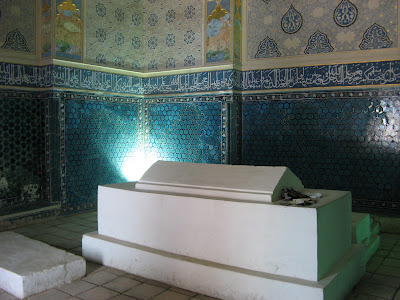
last stop in Samarkand was Shahi-Zinda, which means "Tomb of the living
King". The Shahi-Zinda Ensemble, a necropolis, includes mausoleum and
other ritual buildings of 9 - 14th and 19th centuries. When viewed from outside
and inside, the mausoleums were quite picturesque, all with intricate tile
designs. Most of the mausoleums house Emir Timur and Ulugbeks' family and
their favourites.
 |
| Shahi-Zinda Complex: graveyards and mausoleums |
 |
| Interior of one mausoleum |
 |
| Dome of another mausoleum |
 |
| Inside an octagonal mausoleum :tomb with tiled mosaic walls |
 |
| Picturesque exterior of one mausoleum |
TASHKENT
After touring Samarkand, we headed back to Tashkent. We went for a dinner
and show in Hotel Bahor. The restaurant had an old style Russian-like decor.
Our
4-course European dinner, with wine and vodka, plus live entertainment, was a
change from the usual Uzbek food we had in the ancient towns.
 |
| In a restaurant in Hotel Bahor |
 |
| Meat |
 |
| Cheese and walnut |
 |
| Fish and onion rings |
 |
Yoghurt
|
On stage, beautiful girls in
colourful Western-orientated costumes danced a mixture of ballet, jazz and
other dances from many countries.
 |
Dancers in colourful costumes
|
 |
| Dancers in Western-orientated costumes |
 |
| Dancers danced a mixture of dances |
Next morning, we were introduced to
our new tour guide, Bibi. Bibi took us to see Tashkent’s main tourist sites.
Tashkent, Uzbekistan’s
largest city, has evolved from a small ancient settlement to CA’s largest city
and its main transportation hub. It is different from the other cities we have
visited. It has a combination of medieval buildings, elegant European
architecture, standard concrete ‘boxes’ of the Soviet era and glittering
skyscrapers of glass and concrete.
The Khas Imam Complex is a religious
centre where Muslim relics were collected. It is made up of Tillya Sheikh
Mosque of the 19th century, Barak Khan Madrassah of the 16th Century and
Khaffal Shashi Mausoleum.
 |
| Tillya Sheikh Mosque |
The Barak Khan Madrassah is special as
it is the headquarters for the grand Mufti (who is equivalent to the
"archbishop", for the Stans countries). The oldest reputed Quran of
the world - Osman Koran, is also kept in the Madrassah!
 |
| Barak Khan Madrassah |
 |
| Kaffal Shashi Mausoleum |
Chorsu
bazaar is a "must-visit" bazaar. In ancient times, it was a big
trading place along the Silk Road. The bazaar is the oldest and largest bazaar
in Tashkent. Huge, noisy and busy, it had plenty of farm produce, fruits,
vegetables and spices. As usual, we bought some spices there for home use.
Most
of us liked the Kukeldash Madrassah. It has a baked brick structure - great
architecture that blends well with greenery in its beautiful courtyard. Built
as an Islamic seminary, it served as a local government building during the
revolution. It has a domed courtyard that was a favourite with all of us.
 |
| Beautiful garden in courtyard of Kukeldash Madrassah |
Our last dinner in Tashkent was in Jumanji - a cosy restaurant with fusion
cuisine, a blend of oriental and European dishes. It was a fitting finale to a
wonderful holiday in Uzbekistan.
 |
| Jumanji restaurant with Bibi (far left) |
Uzbekistan is unlike any other country I have ever visited. As a non-Muslim,
I was apprehensive about whether I would be able to relate to its history. At
the end of this trip, I came away with a better perspective of its splendid
monuments, interesting culture, delicious food and most of all, the friendliest
people on earth.
......................................................................................................................................................